How Anchoring Quietly Shapes SaaS Pricing
Why the middle tier wins, and what a fifty-year-old bias has to do with your pricing page
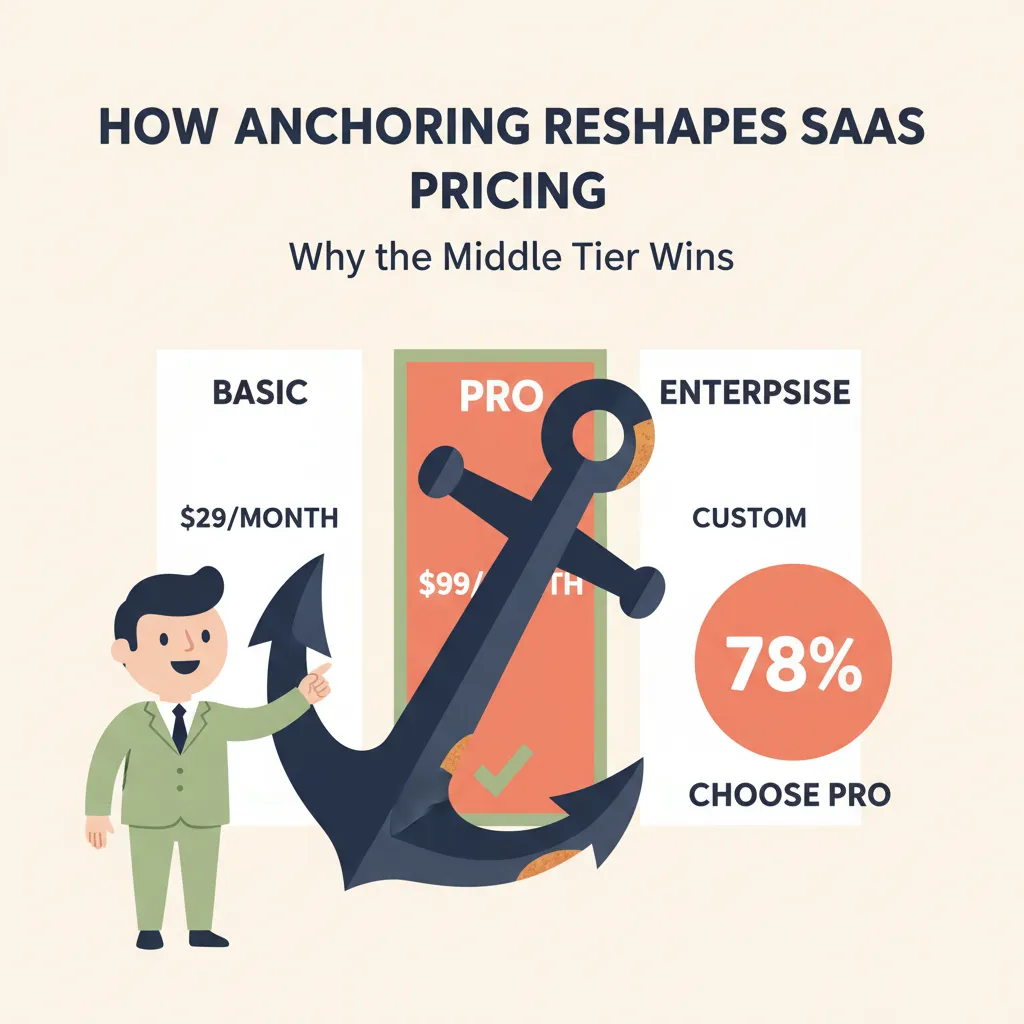
A price is never read as a number; it is read as a distance from the numbers beside it.
Why the First Number Pulls Every Decision
Open any SaaS pricing page and watch your own eyes. They land first on the most expensive plan, drift down to the cheapest line, and finally settle on the middle row.
The decision happens in the center, but the judgment was anchored at the edges. This is the anchoring-effect, an old bias that remains stubbornly active in every pricing table shipped today.
The finding Tversky and Kahneman published in Science in 1974 — that the first number on the page tugs every subsequent judgment toward itself — is still doing its quiet work half a century later.
Why Simple Pricing Beats AI-Optimized Pricing
A 2026 study from UW-Milwaukee’s Lubar College of Business pushes the point further.
Assistant professor Zuhui Xiao argues that even in an era when AI can compute a personalized optimal price for every customer, businesses still earn more profit when they collapse choices into simple, blunt pricing classes.
The reason is mundane: consumers do not evaluate prices in absolute terms. They read each price relative to its neighbors, and the more granular the menu, the more often a higher-priced item registers as a loss rather than an upgrade.
Loss Aversion Punishes Granularity
That is where loss-aversion enters. Prospect theory’s loss function bends roughly twice as steeply on the loss side as on the gain side; the same dollar lost feels heavier than the same dollar earned.
So as soon as a pricing menu fragments, the perceived losses compound. Dynamic pricing, optimized in the narrow sense, can erode profit in the wide sense — because the math optimizes revenue, not the customer’s subjective loss.
Pricing strategy is not a maximization problem. It is the architecture of subjective loss minimization.
The Three-Tier Plan as Architecture
Read against this frame, the three-tier SaaS plan looks less like a sales tool and more like a piece of architecture. The Enterprise plan up top is not really there to be sold.
It is there to anchor the perception of the middle row. The same skeleton powers Apple’s three iPhone sizes, Amazon Prime’s flat shipping fee, and the classic shochiku-bai gradation in Japanese restaurants — a high anchor exists so the next-down option can read as both serious and reasonable.
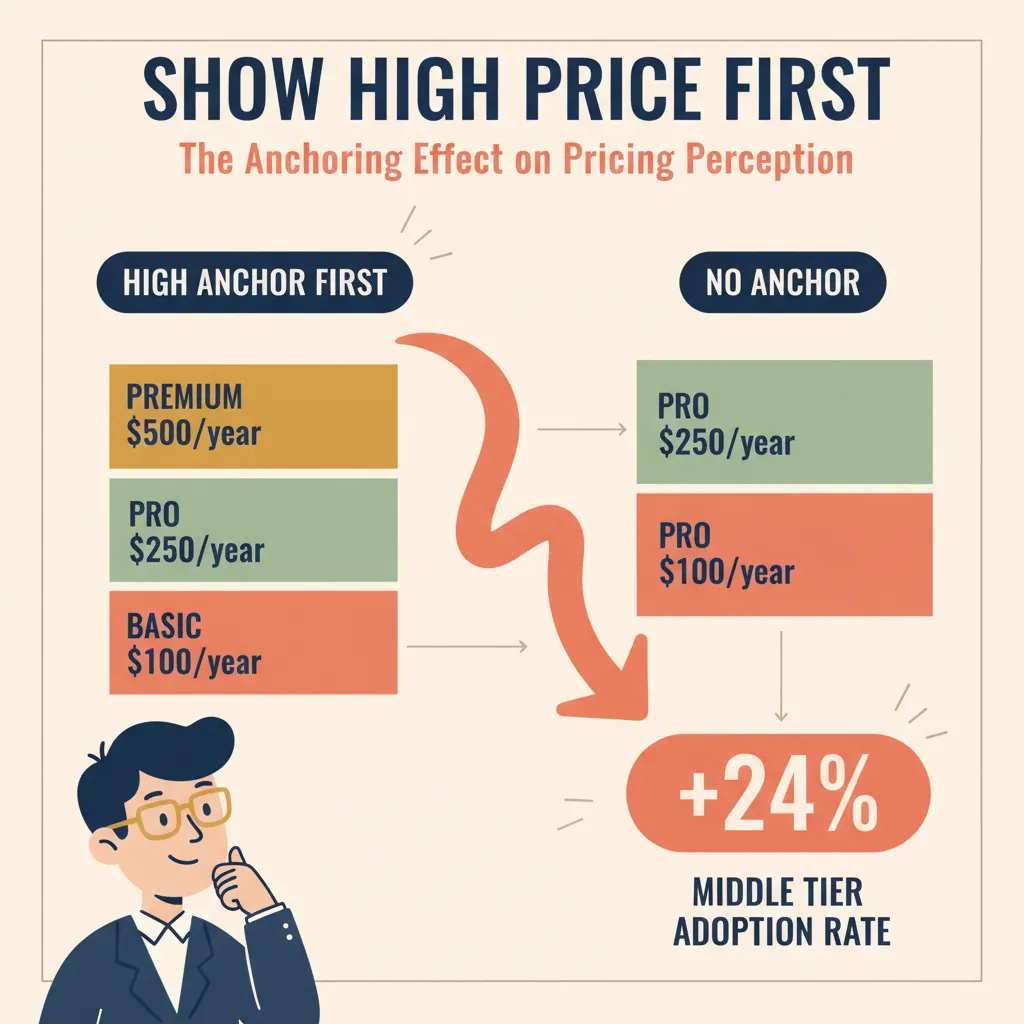
A Pricing Table Is a Blueprint for LTV
Layer ltv on top, and the design takes on a longer half-life. The customer captured at the middle tier carries forward a tidy bundle of psychological costs: money already paid, data already accumulated, habits the team has built.
The anchor that drove the first decision keeps working at every renewal. Pricing is not the price you charge today; it is the frame inside which renewals will be judged for years. Three rows on a page are, in this view, less a UI and more a blueprint for lifetime value.
However finely AI can move a price, the customer’s brain still reads it against neighbors. The leverage is not in finding the perfect single point — it is in arranging the reference points. Three-tier plans are not a relic. They are, as the Milwaukee research quietly demonstrates, a behaviorally optimized structure that has been hiding in plain sight.
Sources: UW-Milwaukee, “The Hidden Psychology Behind Simple Pricing Amid the Rise of AI” (2026); Three Plus Six LLC, primer on the anchoring effect (note, 2026).
Related Articles
"I Hate It" — Yet I Keep Buying: The Behavioral Economics of Random Merchandise
Why B2B Buyers Choose Their Favorite, Not the Best
Designing Sound That Sticks: Brand Memory Lessons from Composer Hiroyuki Sawano
Why Prices Ending in 9 Still Sell

If AI Can't Find You, Your Business Doesn't Start — Adobe CEO on the Agentic AI Gap