Why Prices Ending in 9 Still Sell
Charm pricing, the left-digit effect, and the strange saturation that keeps 60% of retail tags ending in nine
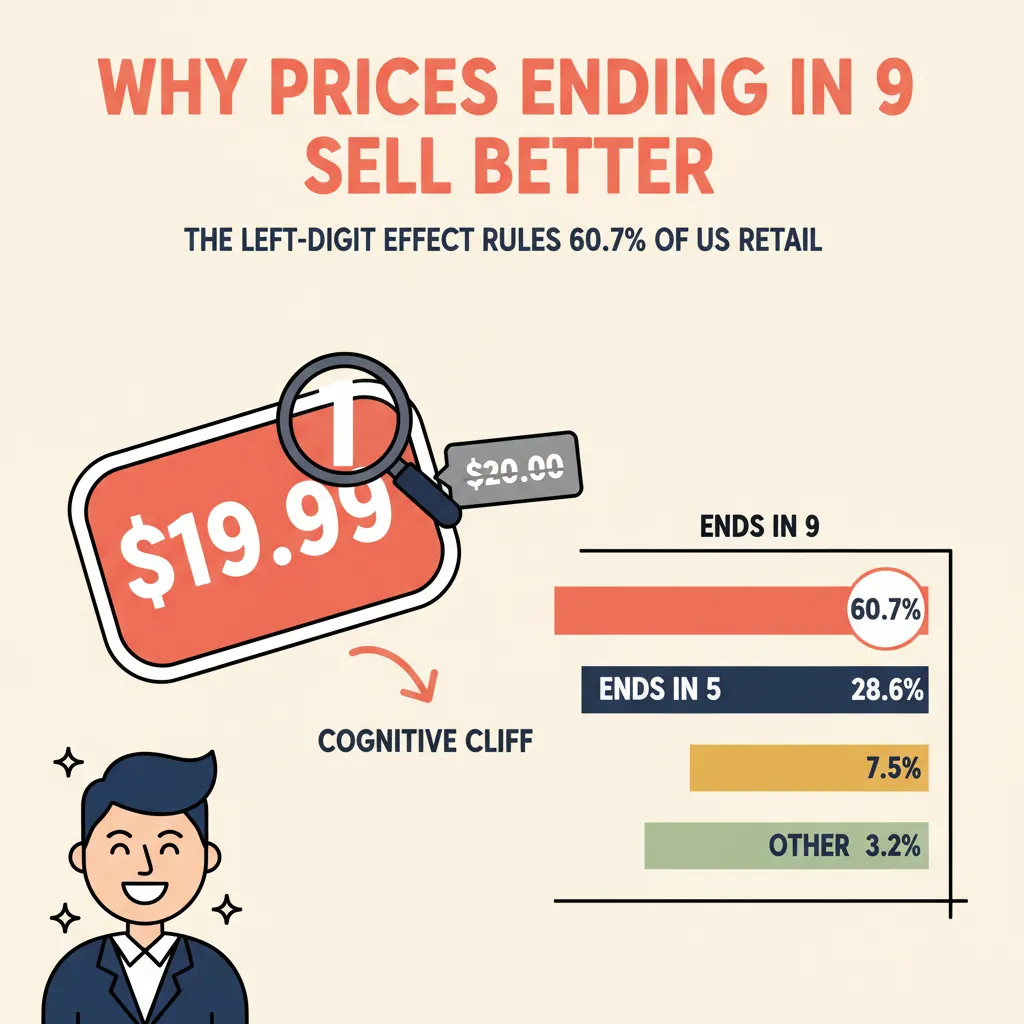
The mental distance between $10.00 and $9.99 is much greater than the distance between $9.99 and $9.98.
How 9 Came to Dominate Retail Tags
Capital One Shopping’s 2026 update on charm pricing statistics returns to a long-known fact.
In US retail, 60.7% of price tags end in 9, 28.6% end in 5, and 7.5% end in 0 — roughly nine in ten prices terminate in either a 9 or a 5.
Tags that end in 9 lift sales by an average of 24%, and an older MIT–Chicago experiment moved demand by 35%. Despite the effect being so well-documented that nearly every competitor uses it, the saturation has not killed the lever. That strange persistence is what makes charm pricing interesting.
The Left-Digit Effect Widens the Cognitive Box
Why does 9 still work? The flat answer — “it looks a bit cheaper” — is not wrong, but the behavioural explanation is sharper.
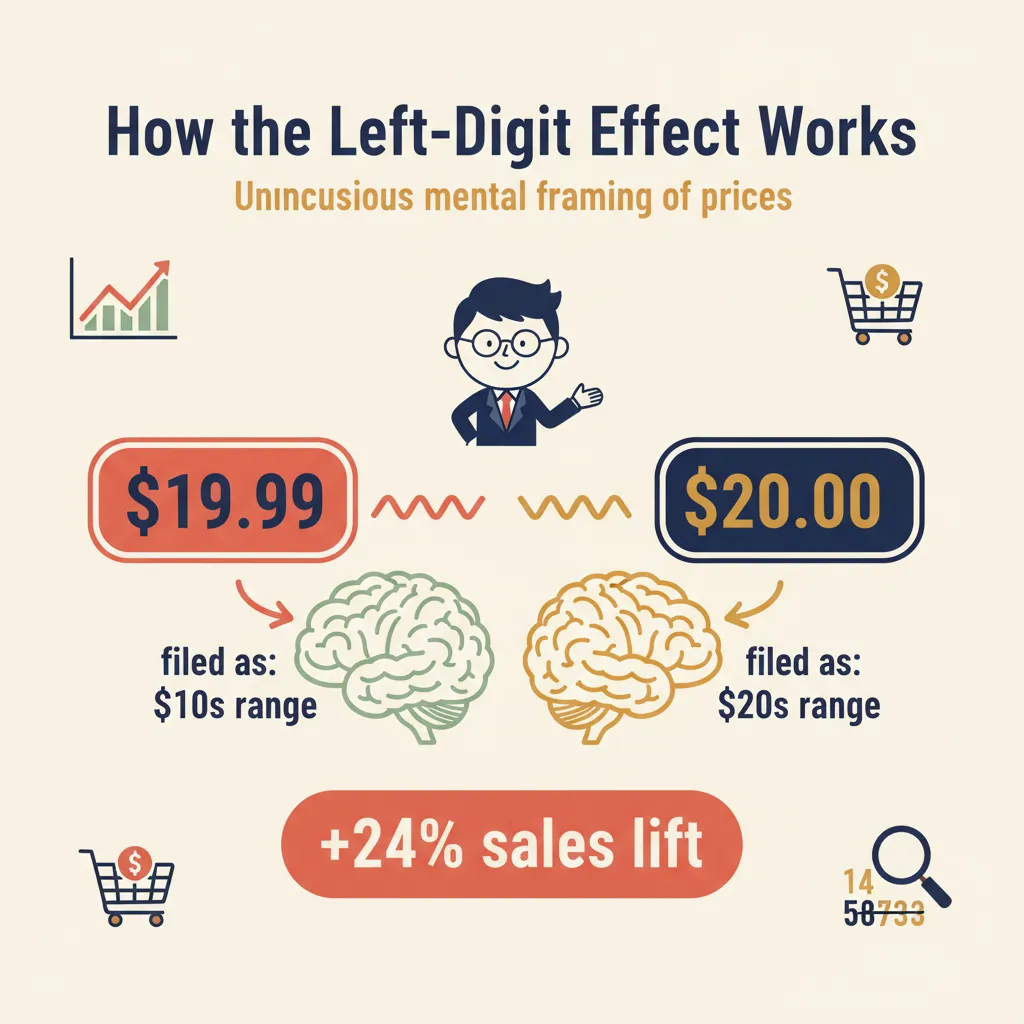
Thomas and Morwitz documented the left-digit effect in 2005: the perceived gap between $9.99 and $10.00 swells the moment the leading digit rolls over.
Because System 1 sorts a price into a band on first glance, $9.99 is filed as “single digits” and $10.00 as “double digits.” The arithmetic difference is one cent. The cognitive box is one tier wider.
Charm Pricing as a Reference-Point Lever
This connects directly to the anchoring-effect. Charm pricing is rarely a stand-alone trick; it works as a way of placing the reference point.
Put $9.90 next to $12.00 and the consumer reads $9.90 as reasonable. Put $10.00 next to $12.00 and the same gap exerts a weaker pull.
A 9 ending tugs the perceived band one step lower, anchoring the eye at the cheaper end of the menu.
The digit 9 lowers the lid of the cognitive box your price gets sorted into.
Saturation and the Luxury Counter-Example
There are two practical caveats. First, saturation. With nearly every competitor using the same ending, differentiation has to live elsewhere — usually upstream of the price tag.
The ad creative, the placement, the headline, the thumbnail — anything that shifts ctr before the user reaches the product page — is where edges accumulate.
Second, the counter-example. Luxury pricing deliberately uses even round endings (¥10,000, ¥25,000) because clean numerals signal prestige. Charm pricing is the mass-market default, but for premium brands the inverse is the rational play.
Japan’s Dual-Price Regulation
A note from Three Plus Six points out that Japan’s “Premiums and Misrepresentation Prevention Act” enforces stricter dual-price display rules than US or EU markets.
A “regular price ¥1,980, today only ¥980” claim requires evidence that the regular price was genuinely in force during a specified period. The 9 ending itself is unregulated, but pairing it with crossed-out “compare at” prices is where compliance risk enters.
The safest default is to simply post ¥980 and let the left-digit effect do the work without a strikethrough.
Use as a Default, Not a Conclusion
A tactic this old should be the default, but never the assumption. Test the change and check both the conversion rate and the average order value.
If a one-cent drop lifts units by 24% and shaves average ticket by 24%, the net is zero. The 9 ending is a strong starting point, not a finish line.
Sources: Capital One Shopping, “Pricing Psychology Statistics 2026”; Three Plus Six LLC, primer on the anchoring effect (note, 2026); Thomas & Morwitz (2005) on the left-digit effect.
Related Articles
How Anchoring Quietly Shapes SaaS Pricing

If AI Can't Find You, Your Business Doesn't Start — Adobe CEO on the Agentic AI Gap
Why B2B Buyers Choose Their Favorite, Not the Best

Why Notion's Onboarding Quietly Works
"I Hate It" — Yet I Keep Buying: The Behavioral Economics of Random Merchandise