Why B2B Buyers Choose Their Favorite, Not the Best
Escaping the commodity race means designing for resonance, not just reach
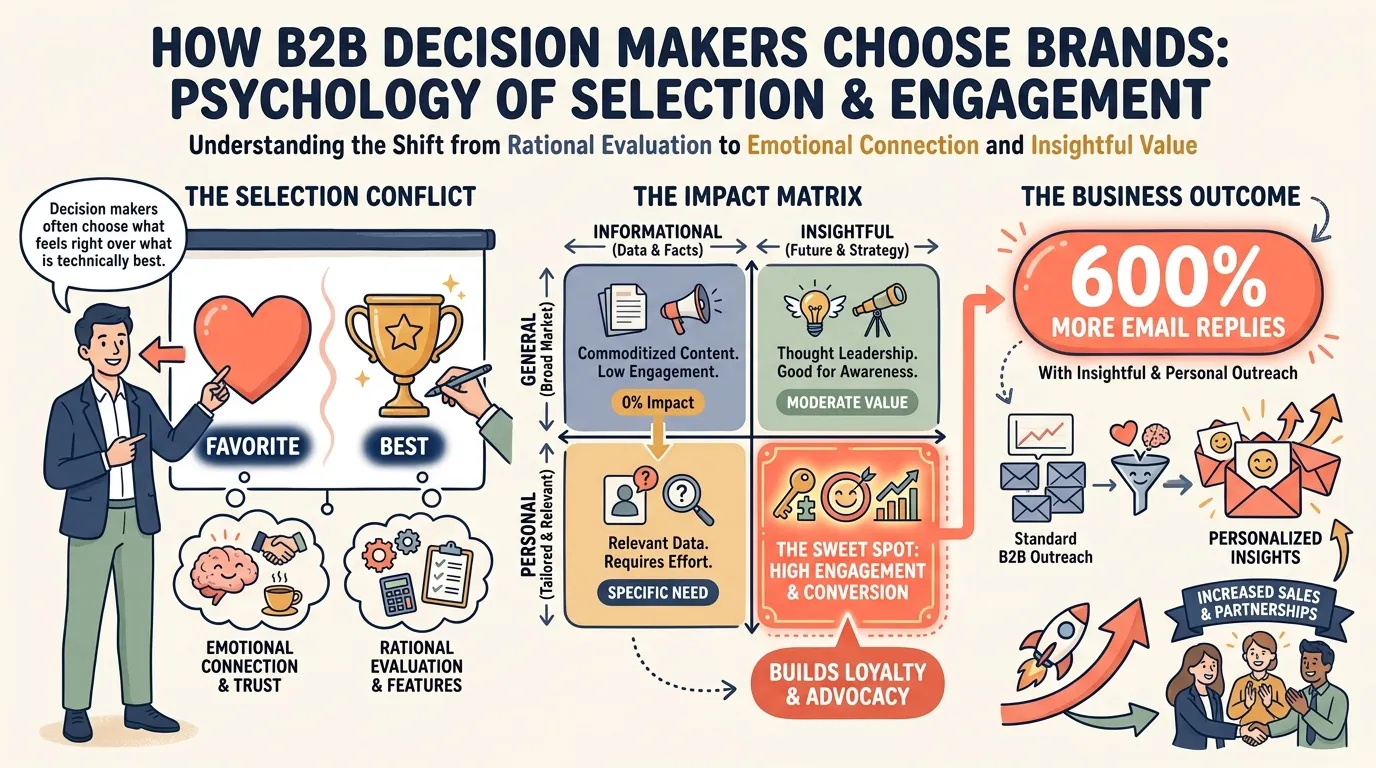
Most B2B marketers are fighting the wrong battle. They stack feature comparisons, sharpen price points, and multiply case studies — and the gap between them and their competitors barely moves. Jay Acunzo, speaking at SparkToro’s Office Hours, offers a sharper diagnosis: people don’t choose the objectively best option; they choose their favorite.
This isn’t a soft claim about feelings. It’s a claim about the structure of decision-making. B2B buyers are human beings whose memories and preferences are shaped by the peak-end-rule: they remember the emotional peak of an experience and its final impression, not the average. Designing for logical superiority, while ignoring story-driven emotional peaks, leaves the most durable purchase driver untouched.
The Marketing Hamster Wheel
Acunzo names the trap precisely: the marketing hamster wheel. More content, more comparison pages, more webinars — but the competition stays neck and neck because every player is arguing for “best” on the same axes.
The problem isn’t reach. It’s narrative-resonance. Getting your message in front of people matters less than having it land and stick. The shift Acunzo calls for is from broadcasting volume to designing resonance.
Diagnosing Your Content with the Impact Matrix
The impact-matrix is a two-axis framework for evaluating content quality:
- Horizontal: Informational (value through information) ↔ Insightful (value through perspective)
- Vertical: General (broad audience) ↔ Personal (rooted in individual experience or viewpoint)
Most B2B content lives in the “Informational × General” quadrant — dense with data, thin on distinctive point of view. Content that produces the favorite-effect lives in “Insightful × Personal”: a defensible claim, derived from lived experience, that no competitor can copy.
![Three-beat storytelling structure: Step 1 'This happened' (speech bubble), Step 2 'Which made me realize' (lightbulb), Step 3 'That's the thing about [topic]' (arrow to audience) — bridging personal story to universal insight](/_astro/inline-1.en.DXYFpf1F_Z1s4CuU.webp)
The Premise: Your One Non-Copyable Asset
The load-bearing element of good B2B storytelling is the premise — a defensible, distinctive claim that only your brand can make. When competitors say “AI streamlines operations,” a premise sounds like “The real barrier to AI adoption isn’t technology; it’s organizational culture.” It doesn’t add to the conversation; it reframes it.
A story without a premise leaves the reader thinking “so what?” — and clicking away to the next tab.
With a premise in place, a three-beat story structure follows naturally:
- This happened — tell a specific, personal observation or event
- Which made me realize — articulate the insight it revealed
- That’s the thing about [topic] — bridge it to the reader’s world
The structure moves from the personal to the universal. Readers feel recognized rather than pitched to, and that recognition is the core mechanism of favorite-effect.
The Bat Story: 600% More Replies
Acunzo’s sharpest example: consultant Michelle Warner told a personal story about bats getting into her house. Her email reply rate went up 600%. Qualified leads rose 150%.
The bats weren’t the point. What worked was the quality of the insight that followed and the irreducible specificity — a story so personal that no competitor could replicate it. That specificity generates narrative-resonance and aligns with what B2B buyers actually want: to trust the person they’re buying from.
The Four-Beat Cadence
Acunzo structures brand storytelling around four beats: Align → Agitate → Assert → Invite.
- Align: Meet the reader where they are — their situation, their frustration
- Agitate: Sharpen the cost of the status quo
- Assert: State the premise boldly
- Invite: Make it feel applicable enough that the reader takes the next step
The shift is from persuasion to invitation. Readers don’t feel convinced; they feel like they figured it out themselves. That’s the moment a brand becomes a favorite.
What to Do With This
Start by listing everything your competitors are also saying. “Cut costs with cloud,” “accelerate decision-making with data” — if multiple competitors use near-identical language, that’s not where your premise lives.
Look for the counterintuitive, the observation that introduces a small crack in conventional wisdom, the failure story no competitor can borrow. Trade reach for resonance when you have to. That’s the bet favorite-effect brands are making.
Sources: B2B Storytelling — How to Make Your Brand Their Favorite (SparkToro Blog, 2026)
Related Articles
Designing Sound That Sticks: Brand Memory Lessons from Composer Hiroyuki Sawano
How Anchoring Quietly Shapes SaaS Pricing
"I Hate It" — Yet I Keep Buying: The Behavioral Economics of Random Merchandise
Why Notion's Onboarding Quietly Works
If AI Can't Find You, Your Business Doesn't Start — Adobe CEO on the Agentic AI Gap